Dummy JSON Data refers to fake or placeholder data in JSON format that developers use for testing, prototyping, or learning. Using dummy data allows developers to simulate real-world API responses without needing a live database or production environment. Dummy JSON data is widely used in web development, mobile app development, and API testing. Developers can generate mock JSON, JSON files, and test data to practice API requests, responses, and manipulate JSON documents efficiently.
What Is Dummy JSON Data?
Dummy JSON Data is a type of mock JSON or dummy data that imitates the structure of real API responses. It can include sample posts, user profiles, comments, or other JSON data. Beginners and developers can use this data to practice parsing, generating, or manipulating JSON files, simulate real requests and responses, and work offline without a live server or database.
Why Use Dummy JSON Data?
Dummy JSON data is helpful for several purposes:
• Testing APIs: Simulate real API responses before the backend is ready.
• Front-End Development: Build and test UI elements using realistic JSON data.
• Learning and Practice: Beginners can manipulate sample JSON, mock JSON, or dummy data without connecting to a live database.
• Prototyping Applications: Quickly create dashboards, apps, or UI elements using dummyjson or generated JSON files.
Example of Dummy JSON Data
Here is a sample JSON file used as dummy data:
[
{
"id": 1,
"name": "John Doe",
"email": "john@example.com",
"age": 28
},
{
"id": 2,
"name": "Jane Smith",
"email": "jane@example.com",
"age": 32
}
]
This is mock JSON data, but it mimics the structure of real API responses. It’s perfect for testing JSON files, generating sample data, and working with API request and response bodies.
Where Dummy JSON Data Is Used
Dummy JSON and mock JSON resources are widely used across:
• Frontend Frameworks: React, Angular, Vue
• Backend Development: Node.js, Python, Java
• API Testing Tools: Postman, Insomnia
• Learning Platforms: Coding tutorials and bootcamps
• Sample Projects: E-commerce apps, dashboards, social apps
Benefits of Using Dummy JSON Data
• No need for a live database
• Saves development time
• Easy to test and debug applications
• Enables offline development
• Helps simulate real-world API scenarios and JSON data
Popular Sources for Dummy JSON Data
Developers can access dummy JSON data from:
• JSONPlaceholder (https://jsonplaceholder.typicode.com)
• FakeStore API
• Mockaroo
• Randomuser.me API
• DummyJSON.com
Conclusion
Dummy JSON Data is a powerful tool for developers to test, prototype, and learn without relying on live production data. It allows you to generate sample JSON, mock JSON responses, practice API requests and responses, and build functional UI elements efficiently. Using dummy JSON, JSON files, and test data can significantly speed up development and simplify working with API resources, requests, and responses.
Understanding Your Dummy Data: A World of Possibilities
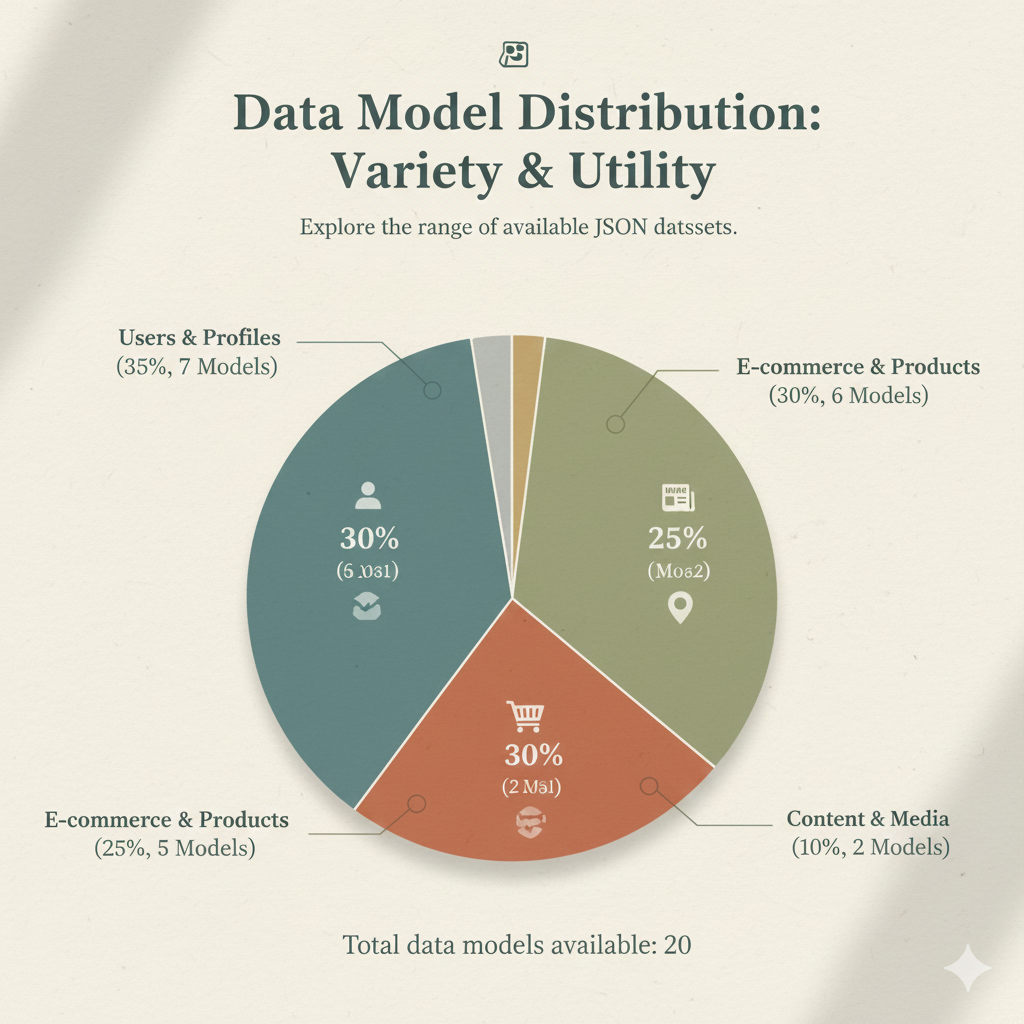
Our dummy JSON data generator is designed to cover a broad spectrum of real-world use cases, providing you with diverse datasets to power your development, testing, and prototyping needs. This chart illustrates the distribution of the 20 unique data models available, showcasing the variety at your fingertips.
Key Takeaways from the Chart:
- Users & Profiles (35%, 7 Models):
- Content: This is our largest category, reflecting the universal need for realistic user data. It includes comprehensive models for individual users, employee directories, customer lists, and authentication profiles.
- Utility: Ideal for populating user interfaces, simulating login flows, testing user management features, and developing personalized experiences.
- E-commerce & Products (30%, 6 Models):
- Content: A substantial portion of our data models is dedicated to the e-commerce domain, featuring products with detailed attributes, order histories, shopping carts, and inventory lists.
- Utility: Perfect for building online store interfaces, testing product display pages, simulating order processing, and developing inventory management systems.
- Content & Media (25%, 5 Models):
- Content: This category provides structured data for blogs, articles, social media feeds, comments, and media assets.
- Utility: Essential for developing content management systems (CMS), building news aggregators, testing social media integrations, and prototyping media galleries.
- Geo & Technical (10%, 2 Models):
- Content: While a smaller segment, these models are crucial for specialized applications, including geographical locations (cities, countries, coordinates), technical configurations, and simplified log entries.
- Utility: Useful for mapping applications, testing location-based services, simulating device configurations, or creating simplified system logs for analysis.
Why This Distribution Matters to You:
- Comprehensive Coverage: No matter your project type, from social apps to e-commerce platforms, you’ll find relevant and structured data.
- Rapid Prototyping: Quickly grab a suitable dataset to bring your UI to life, without spending hours manually crafting data.
- Robust Testing: Utilize a variety of data types to ensure your application handles different data structures and values gracefully.
- Scalability: Understand the breadth of data you can generate, helping you plan for future development needs.
Leave a Reply