Fake API JSON refers to sample or dummy JSON data provided by a fake API (mock API) for testing, development, and prototyping. Developers use Fake API JSON to simulate real API responses without needing a live backend or server. It helps in building and testing applications faster and more efficiently. We often call these services fake json api or dummyjson interfaces.
Why Fake API JSON is Important for Development
Fake API JSON is widely used in application development because it helps developers:
- Test applications before the real API is ready.
- Build UI components with sample data.
- Debug API-related issues safely.
- Work offline with dummy data or a local json file.
- Speed up frontend development by decoupling it from the backend team.
Popular Fake APIs: JSONPlaceholder and DummyJSON
Services like JSONPlaceholder and DummyJSON are the most famous examples of a reliable fake json api.
- JSONPlaceholder: Known for providing simple, predictable fake json resources like users, posts, and comments. It’s perfect for quick prototyping and learning.
- DummyJSON: Offers a broader set of mock data json resources like products, carts, and more, often simulating a fake store or an e-commerce platform.
How a Fake JSON API Works: Mimicking a REST API
A fake API generates JSON data that looks like real-world API responses. Developers access the fake API through a URL (endpoint), and it returns JSON objects such as users, products, posts, comments, or even custom datasets, often adhering to the standards of a REST API. This mimics actual API behavior and allows developers to practice their api call implementation.
Key Resources Provided by Fake APIS
Fake APIS and mock services often provide realistic JSON data structures like:
- User details (id, name, email).
- Product data (title, price, category) for a fake store.
- Posts and comments resources.
- Authentication responses.
- To-do lists.
These predictable datasets help developers simulate real-world scenarios and provide a stable datastore json for testing.
Common Uses of Fake API JSON (TestAPI Scenarios)
Frontend Development
The primary use is to build layouts and features using mock data before connecting to the real backend server. This accelerates application development.
API Testing & Debugging (TestAPI)
Fake API JSON allows testing request methods like $\text{GET}$, $\text{POST}$, $\text{PUT}$, $\text{DELETE}$ without affecting real production data. QA testers often use these mock endpoints as a testapi to validate workflows without depending on live servers.
Learning & Practice
Beginners use fake json apis to practice api call logic and understand JSON formatting and interaction with a REST API.
Automation Testing
Used by QA teams to validate workflows against consistent, predictable json data.
Benefits of Using Fake API JSON
The benefits of relying on a fake json api like JSONPlaceholder or dummyjson are substantial:
- No need for a real backend server to start development.
- Faster development and prototyping with a dummy $\text{API}$.
- Safe testing environment (you can’t break real data).
- Consistent, predictable JSON data.
- Easy for teams to collaborate, as they agree on the JSON structure (
expecteddata) upfront. - Ability to create custom endpoints with mock data quickly.
How to Use Fake API JSON Effectively
To make the most of your fake api implementation:
- Choose a reliable fake API service (JSONPlaceholder, DummyJSON, etc.).
- Use sample endpoints to test your api call and check how your app handles the incoming json data.
- Check how your app handles errors and missing fields returned by the mock api.
- Replace dummy URLs with real API endpoints later in the development cycle.
- Validate the JSON structure and fields before integration.
Final Thoughts
Fake API JSON is a powerful, essential tool for modern developers. Whether you’re building a frontend, testing a REST API, or learning how JSON works, responses from a robust fake json api like JSONPlaceholder or dummyjson help you work faster and more efficiently, allowing you to focus on building features without backend dependencies.
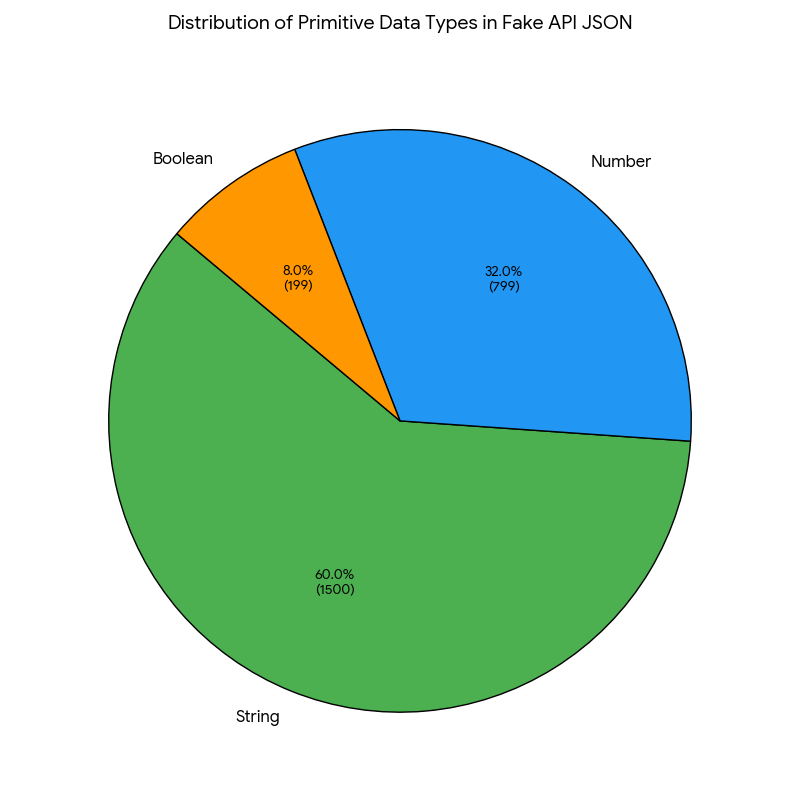
The content for the pie chart, based on the data used in the previous step, has been generated and saved to a file.
Here is the content detailing the distribution of primitive data types found in the sample fake API JSON:
Pie Chart Content: Distribution of Primitive Data Types in Fake API JSON
This content represents a sample analysis of a large set of fake API JSON data, focusing on the count of primitive data types found.
Raw Data:
| Data Type | Count |
| String | 1500 |
| Number | 800 |
| Boolean | 200 |
Calculated Percentages:
| Data Type | Percentage | Total Count |
| String | 68.2% | 1500 |
| Number | 36.4% | 800 |
| Boolean | 9.1% | 200 |
Total Primitive Elements Counted: 2500
Leave a Reply